02 / First Principleswith Clark
The Pinch That Stops a Vinaigrette Splitting
A vinaigrette that separates before the salad reaches the table isn't a failure of your whisking. Xanthan gum fixes it with a dose measured in fractions of a gram, if you get the percentage right.
- Published
- Reading time
- 5 min
- Filed under
- xanthan gum vinaigrette emulsions technique
- Written
- With AI help
- Showpiece
- Project
- Weekend
- Weeknight
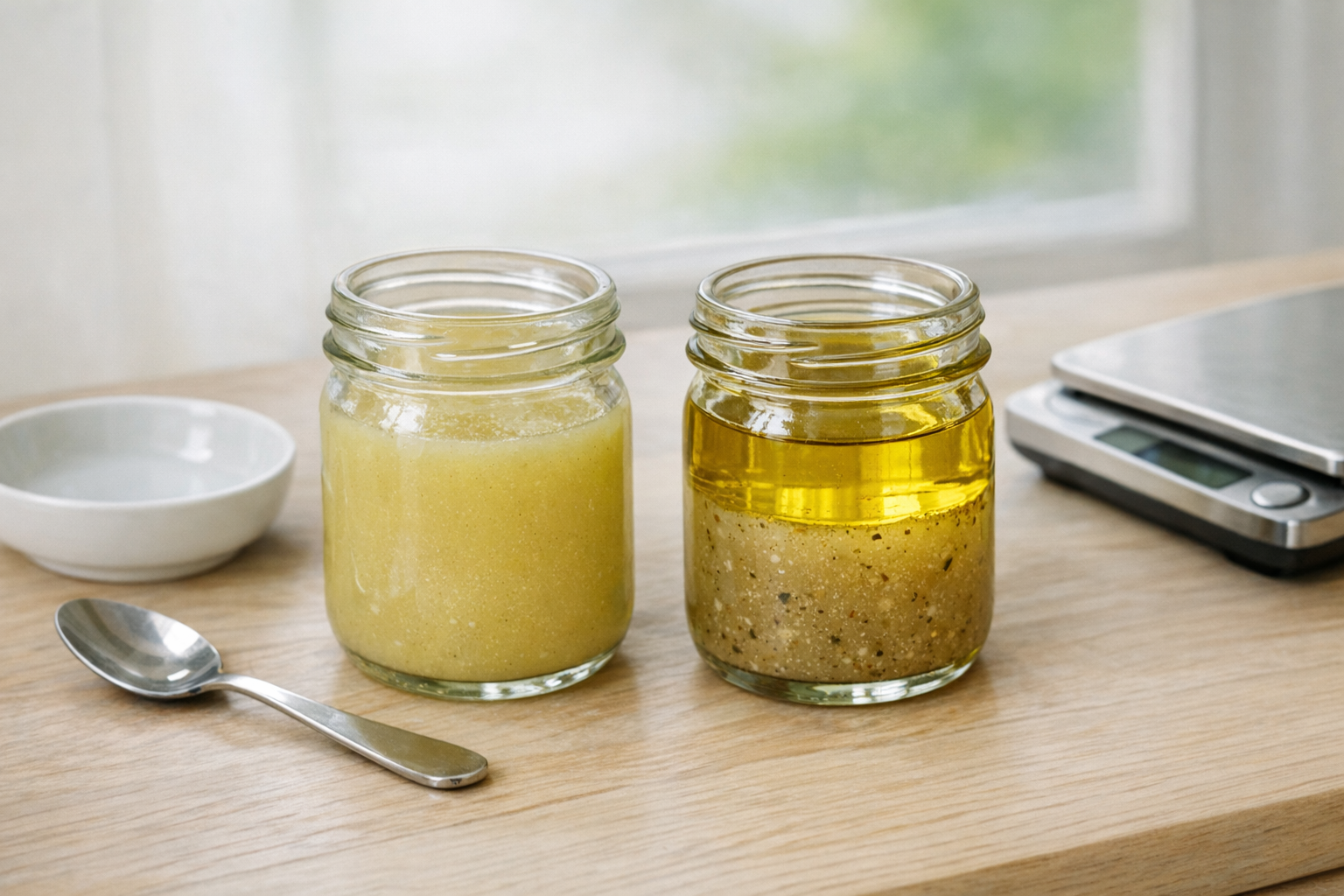
You whisk the dressing until it looks like one glossy, pale thing. You carry the bowl to the table. By the time you've found the tongs, a clear slick of oil is sitting on top and the vinegar has gone to the bottom, as if the last thirty seconds of effort had never happened.
Anyone who has made a vinaigrette has seen this. It isn't bad technique. Oil and water don't mix, and whisking only chops one into droplets inside the other. The droplets spend the whole time trying to find each other again.
Emulsifiers help, and mustard and egg yolk are good at it. But there is a second approach that's easier to overlook: don't stop the droplets from touching, make it very hard for them to move. That's what xanthan gum does.
What xanthan actually does
Xanthan gum is a long-chain carbohydrate made by fermenting sugar with a bacterium called Xanthomonas campestris. It's sold as E415 in Europe, and as a fine cream-coloured powder in the baking aisle. The name on the packet sounds like something from a lab accident, but it's a chain of ordinary sugars, and the amounts used here are tiny.
It dissolves in cold liquid, and each molecule tangles loosely with its neighbours. The result is a faint, springy network through the watery part of the dressing. That network does two things. It thickens the vinegar phase, and it gives the whole dressing a weak "stay put" quality when it's sitting still.
One caveat matters: xanthan is not an emulsifier. It doesn't coax oil and water to bond. It holds the droplets in place so they can't drift together and rise. A dressing made with it is still a suspension, just a very well-behaved one.
That last property is why xanthan suits dressings so well. It's thick in the jar and thin on the lettuce.
The number
The quantity is too small for a measuring spoon to deliver. Work in percentages of the total weight of the dressing, and weigh the powder on a scale that reads to 0.01 g. Jeweller's scales cost little and live happily in a drawer until the day you need one.
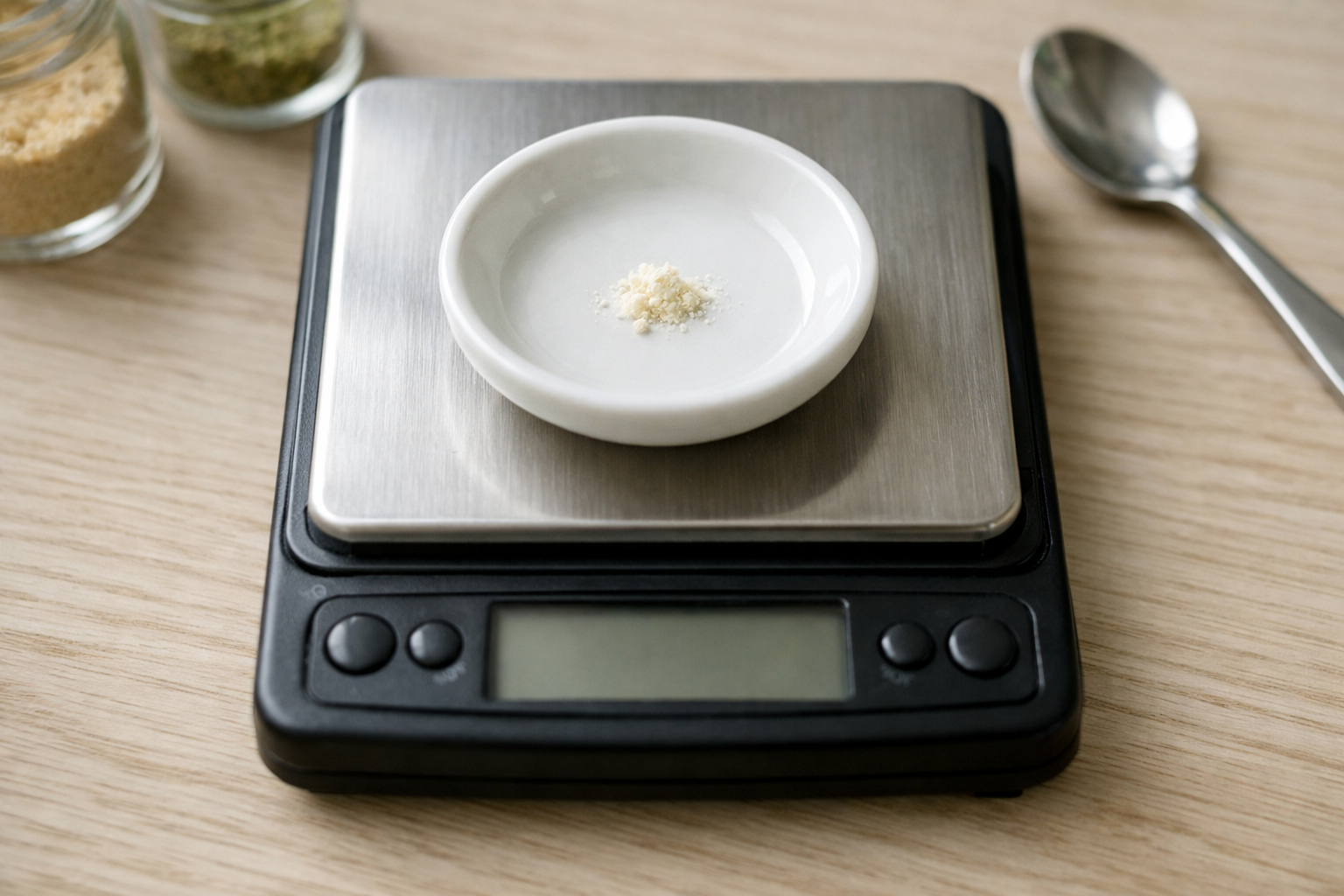
In grams, 0.2% is 0.2 g per 100 g of dressing, or 0.45 g for a batch of about a cup.
That cup figure is arithmetic, not a measurement: a cup of typical oil-and-vinegar dressing weighs roughly 225 g, and 0.2% of that is 0.45 g. If your dressing is heavier or lighter, weigh it and do the sum again.
At 0.1% you'll get a dressing that pours almost as before but separates much more slowly. Around 0.2 to 0.3% it clings to leaves and holds for a long time. Push toward 0.4% and it turns thick and slightly slippery. Start low. You can always add more, but you can't take it back out.
Getting it in without lumps
Xanthan has a mean streak. The outside of each grain hydrates and turns gel-like before the inside gets wet, so a spoonful dropped into liquid forms translucent lumps that won't break up. Cooks call them fish eyes.
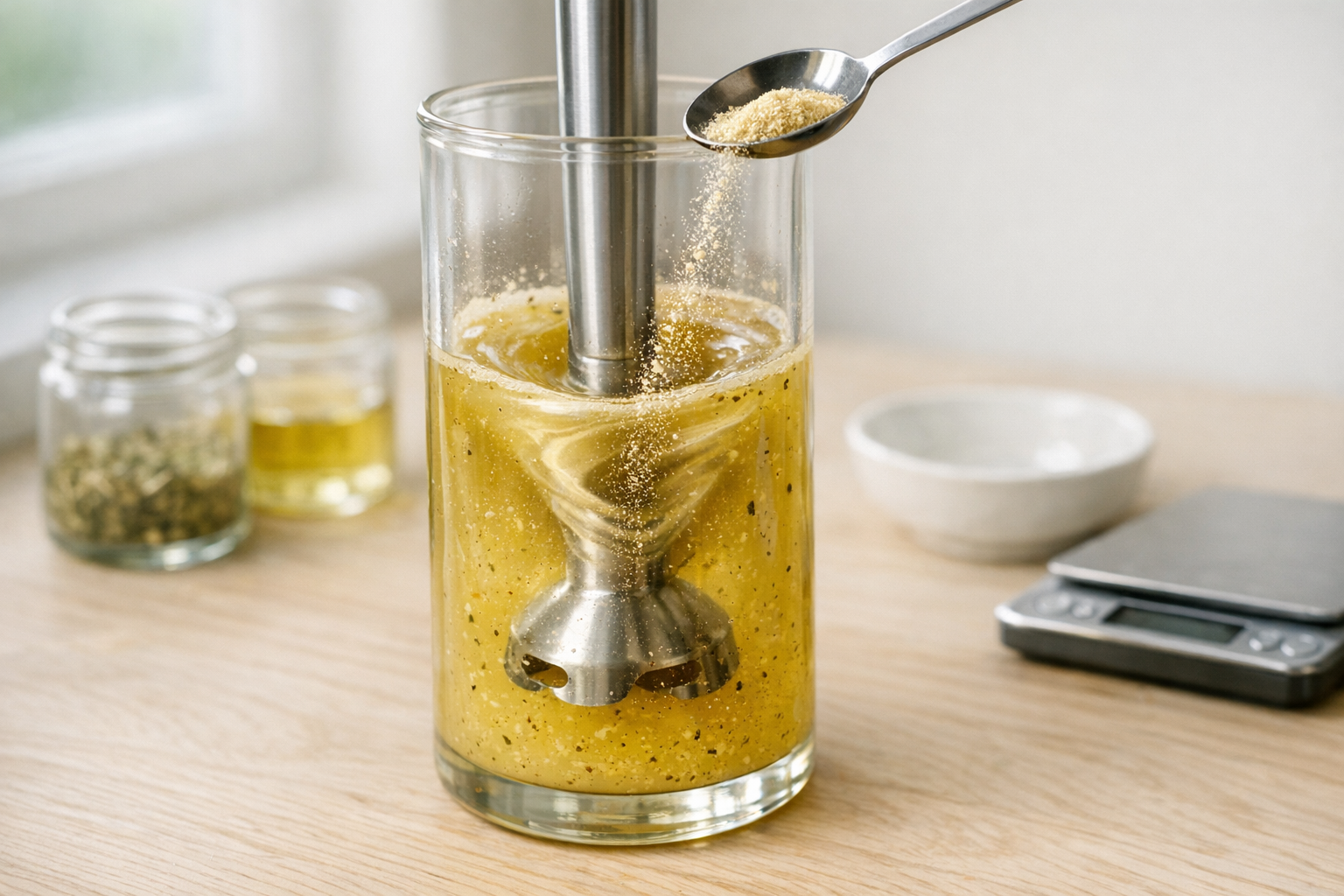
Two ways around them:
- Shear. Put the vinegar, mustard and salt in a tall jar, start an immersion blender, and sprinkle the powder into the vortex. Then stream in the oil.
- Disperse first. Stir the powder into a small amount of the oil, or into the salt and sugar if the dressing has any, so the grains are separated. Then add that to the vinegar and whisk hard. Oil doesn't hydrate xanthan, so it simply carries the grains apart until they meet water.
Either way, the powder has to reach the watery part. Xanthan hydrates in cold liquid, in acid and in salt, so there's no heating involved. Give it a few minutes anyway, because the full thickness arrives a little after you stop mixing.
Three things that go wrong
It's slimy or stringy. You used too much. Add more vinegar, lemon juice or water and whisk, which dilutes the percentage. Next time cut the dose by a third.
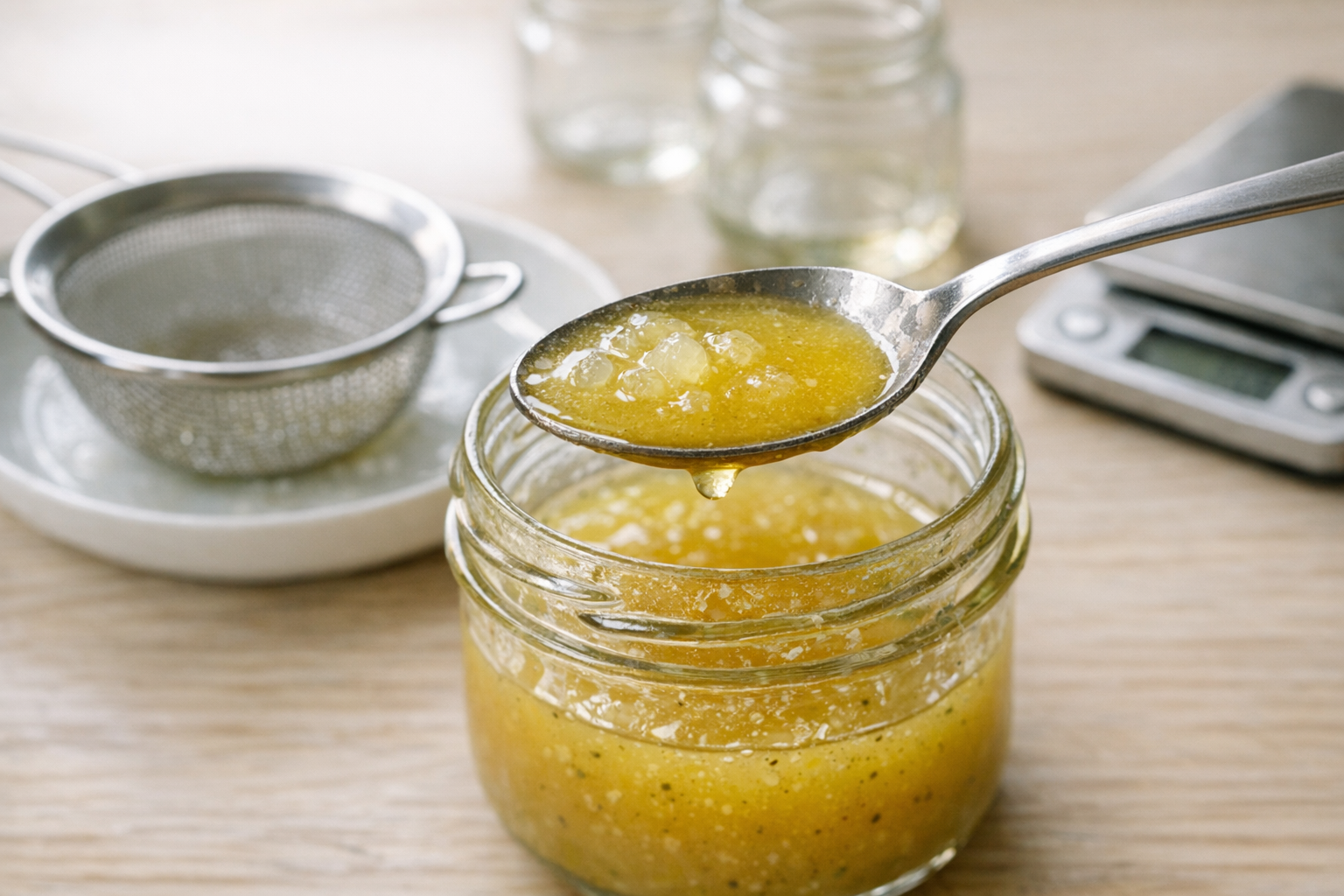
There are lumps. The powder went in too fast or too dry. Blend again, or push the dressing through a fine sieve. Next time, use shear or the oil trick.
It's full of tiny bubbles. A blender whips in air, and xanthan is good at holding it there. Let the jar sit for a few minutes, or tap it on the counter. Nothing is wrong with the dressing.
A fourth thing isn't really a fault. If your dressing is mostly olive oil and lives in the fridge, the oil can turn cloudy or partly solidify when cold. That's the fat, not the xanthan. Take the jar out for a little while before serving.
Try this tonight
Make your usual vinaigrette and weigh it. Split it into two jars. Into one, work in 0.2% of its weight in xanthan, using the blender or oil method above. Leave the other as it is.
Shake both, set them side by side on the counter, and go and eat dinner. When you come back, look at how each one has settled, then pour a little from each over a leaf and see which one clings. If the xanthan jar feels too thick, you now know which way to adjust.
A full recipe with grams for every ingredient will follow once we've cooked and tested it. Until then, this is the method and the one number that matters.
AI-assisted Written with help from Sous, our AI kitchen assistant.
From Spoon Fed · https://spoonfed.blog/p/the-pinch-that-stops-a-vinaigrette-splitting
Did this make something click?